The Best Homeschool Schedule Tips for Multiple Grades
Getting started with homeschooling can be a challenge, and one of the hardest parts for many families is creating a homeschool schedule for multiple grades. Even though I’m an experienced homeschool parent and former teacher, I still spend time each school year creating a daily routine for my family that allows me to homeschool multiple grade levels each day. It can be a challenge to make sure that each child gets the personalized education they deserve, all while managing different curriculums, schedules, and milestones. Thankfully, the advancement of technology has introduced user-friendly apps that can make scheduling and organization much easier. In this post, I’ll share my favorite tips for creating a homeschool schedule that works for younger kids and older kids alike. With these ideas, you’ll be ready to create the perfect schedule for your family’s homeschooling journey.

I received compensation and access to Beehive in exchange for my honest review, but all the opinions in this post are my own.
Why a Homeschool Schedule is Crucial
Establishing a daily homeschool schedule is one of the most important things you can do to set your family up for success in your homeschool. Here’s why.
- Clear Expectations and Routines: The structure of a consistent homeschool schedule provides security for both younger children, who might need more guidance, and older children, who are venturing into independent work.
- Maximize Learning: Having a consistent schedule allows families to get more learning done in less time than kids in traditional schools do.
- Individual Attention: Creating a schedule means more time for personalized attention for each child. When kids get individual attention, they can focus on topics they’re passionate about instead of having to wait for the rest of the class to learn things they might already know.
- Independence: Having a set homeschool routine also means older children, especially high school students, can manage their own schedules. This might give them time for things that are important to them, like piano lessons or social media breaks.

The Difference Between Homeschool and Regular School Schedules
Unlike a traditional school, where the day is often segmented into specific times for subjects like language arts or social studies, a homeschool routine allows for flexibility throughout the homeschool day. Many families find that a rhythm where they complete subjects in a specific order works better than a more rigid schedule with times attached.

Types of Homeschool Schedules
No matter how old your kids, are, navigating the homeschooling journey requires a lot of planning. While there are numerous approaches to structuring schoolwork, some types work well for homeschool families because they are efficient and flexible.
Block Schedule
One of these is the Block Schedule. In this setup, families dedicate extended periods, or blocks, of time to specific subjects. For instance, your homeschooling day might begin with an hour-long deep dive into math, followed by a similar block for language arts. The strength of block schedules lies in their ability to encourage concentrated learning, which is especially beneficial for complex topics. However, the challenge surfaces when younger children, who may have shorter attention spans, find it hard to stay engaged for extended periods.
Relaxed Schedule
Another common choice among homeschool parents is the Relaxed Schedule. Unlike a traditional school schedule, this approach doesn’t use specific times of the day. Instead, parents follow the pace and interests of each child. This schedule is ideal for families who value flexibility and want to prioritize learning through life experiences. It can work really well for families with young children who prefer a mix of structured learning and free time.
Loop Schedule
For families juggling the educational needs of children of different ages, the Loop Homeschool Schedule can be a game-changer. A loop schedule is designed around a list of tasks instead of a daily schedule. If your 6th grader is engrossed in a science experiment and wants to extend it beyond the allotted time, no problem! You simply continue with the next subject the following day, which means that nothing is missed. This approach is great for larger families where rigid schedules can be extra challenging.
Checklist
The Checklist approach works well with older students and high schoolers. Families create a to-do list of tasks students need to complete either daily or weekly. Independent learning is important with a checklist, since older children have the responsibility to manage their own time.
Steps to Create a Multi-Grade Homeschool Schedule
Crafting an effective homeschool schedule for multiple grades can be a challenge. Families need to balance respecting the individual learning needs of each child, while also considering the needs of the family overall. Here’s how you can approach it:
Understanding Each Grade’s Requirements
Each age and grade level has its own unique requirements. This means that sample homeschool schedules for each family will be different, depending on the ages of their kids.
- Kindergarten: This is a time of foundational learning. In your homeschool schedule for kindergarten, make sure to focus on core subjects but remember the importance of keeping sessions short and interactive to match your 5-year-old’s attention span. This is their first big step in the homeschool journey.
- 1st to 5th Grade: As children progress, they will start to learn more advanced concepts. Their lessons will still be short and they will not spend as much time during the day working on school as traditional students will.
- Middle School (Junior High): Here, lesson durations might increase as topics become more intricate. There’s a shift towards specialized subjects and promoting independence in learning. For instance, a student might spend a specific time on group work projects or dive deeper into a particular subject they show interest in.
- High School: These years are pivotal. Incorporate checklists to foster student autonomy. It’s also the phase to begin preparing them for higher education through specialized subjects, extracurriculars, or college prep activities. A weekly schedule can also help in managing their diverse requirements.
Homeschool Schedule Tips to Keep in Mind
- Balancing Core Subjects with Extracurricular Activities: While core subjects are important, kids also need exposure to extracurriculars like physical activity, art, foreign language, and music. Make sure to find time for these subjects too!
- Incorporating Flexibility: Make sure your family’s schedule includes quiet time, breaks for each child to play independently, and plenty of margins to accommodate last-minute opportunities that come up.
- Including breaks: Remember, a day full of only academics can be exhausting. Incorporate short breaks that give kids an opportunity to get up and move between subjects.
- Follow your child’s individual pace: Some days might be harder than others. But as homeschoolers, we can slow down when our kids are having a hard time and help them learn at their own pace.
Using Technology to Manage Your Family’s Schedule
As technology continues to advance, there are more and more options for homeschool parents to manage their homeschool schedule right from an app. Planning no longer has to take place on a large family whiteboard in the kitchen or in a paper planner. Digital tools, especially specialized apps, have transformed how many families schedule, organize, and even learn in their homeschools.
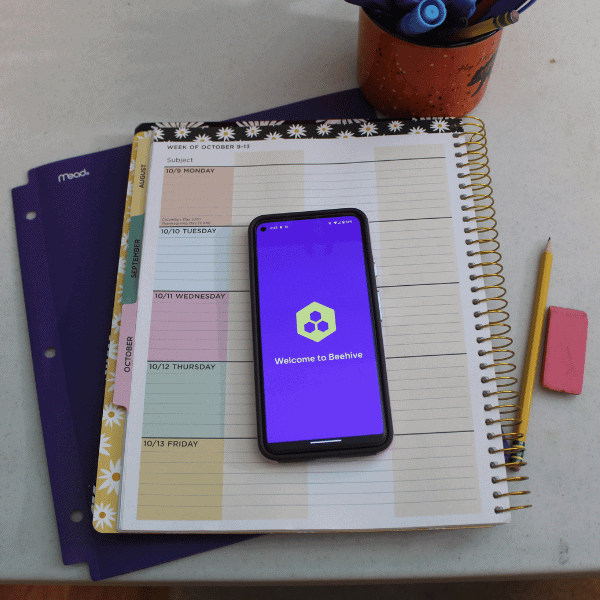
One of my favorite new apps is Beehive. This app is designed for parents (not business professionals) and gives us the opportunity to organize our whole family’s schedule, track grades, and even teach our kids from one centralized app. With apps like Beehive, homeschooling moms and dads can stay on top of assignments, ensure no events are missed, and adapt to the unique schedules of their kids. I love how Beehive helps me keep track of all the different pieces of my life, right in one app!
Household Organization and Schedules
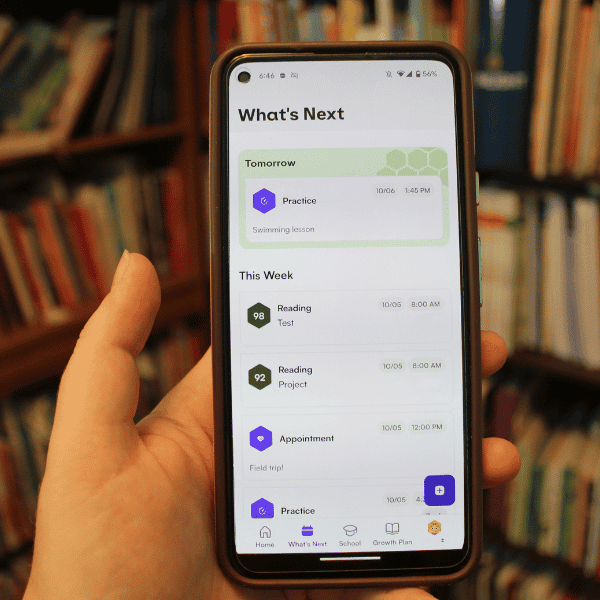
Organizing a family, especially a homeschool family, is always a challenge. Thankfully, tools like Beehive make the job not just simpler but also more efficient. I love the way that this app consolidates all of my family’s upcoming appointments, lessons, activities, and even chores right on the “What’s Next” screen. I don’t have to rely on sticky notes or a whiteboard; everything is available at a glance on my phone. And the best part is that because the whole schedule is digital, I can share it with my husband to make sure that we are on the same page!
Weekly reminder emails help me plan ahead, and all the events I add into Beehive sync to my Google calendar automatically.
This year my family is participating in a co-op and my kids each have a new extracurricular activity. I love that this technology allows me to stay organized and to see all the day’s activities at a glance. I don’t know what I would do without it!
And the best part is that the more organized I can be, the more free time I find to have fun with my kids and make the most of each day, or just relax and recharge.
Learn more about staying organized with Beehive here.
Tracking Progress and Grades
Beehive makes it really easy to enter each child’s grades on assignments, quizzes, tests, and projects right in to the app. Grades are stored in the “School” tab for each child, and I can easily toggle between kids to keep track of my whole family’s progress throughout the school year.
I love that all the grades are graphed on the overview tab so that I can see each child’s progress visually. I am a visual learner, so I always love any time that I can see a graph.
And, these records are permanent which means I can keep tracking even if we switch to a different school situation next year. This gives me so much peace of mind to know that I can keep using these records year after year.
Beehive even allows me to add highlights so I can store a picture or note about something I want to remember.
Learn more about keeping track of progress with Beehive here.
Growth Plans
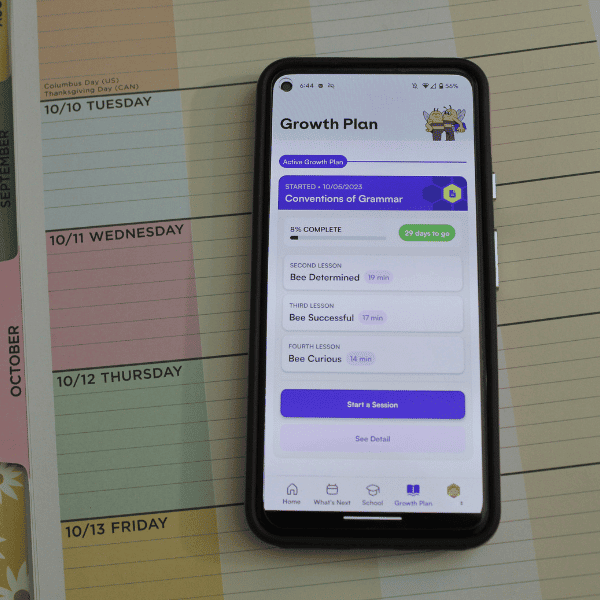
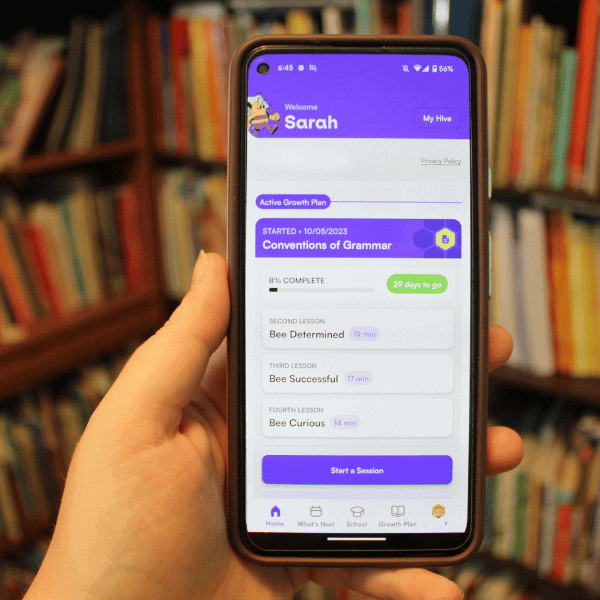
This feature is awesome for homeschool families! Growth plans are done-for-you unit studies that you can assign to your child with just a couple of taps. They are perfect to help kids maximize their potential. Parents can use them as extra practice for kids that are struggling, or enrichment for kids that need a little extra challenge.
My son who is in 3rd grade doesn’t like to study language arts so I was noticing that he was behind on some of the topics I wanted him to know. I chose a growth plan for him that focused on grammar and parts of speech.
The growth plan included video lessons and quizzes. I love that he can complete all the lessons on his own and that he can get some extra practice with a topic he needs to work on. I also love that I didn’t need to do any lesson planning or find any extra resources for him. Everything he needs is already included in the Beehive app!
Check out all of Beehive’s parenting resources here.

Try Beehive for Your Family’s Homeschool Schedule
Creating a homeschool schedule for multiple grades and keeping track of your family’s schedule can be a challenge. But, apps like Beehive make administrative tasks much easier for homeschool families. If you are looking for an app that is created for parents to help you manage your schedule and your kids’ progress in school all in one place, I would definitely recommend Beehive. This app is a great way to stay organized with all the moving pieces of life as a busy homeschool family.
Learn more about Beehive and get a subscription for your family here.