5 Simple Tips to Improve Handwriting for Children
Having good handwriting is an important skill for kids. However, many children struggle with handwriting. Here are 5 tips to improve handwriting for children. Try these actionable strategies in your homeschool! And you can download fun free bug-themed handwriting pages to use with your kids today!

I only recommend products that I use and that we love. This post may contain affiliate links and I may earn a small commission for purchases made through those links.

1. Identify the problem with your child’s handwriting
The first step to helping your child improve their handwriting is to figure out what the problem is. Most of the common problems with handwriting for children can generally be divided into 3 categories.
- Pencil grip: It is extremely difficult for a child to write with good handwriting when they are not holding their pencil correctly. Teaching kids to use a correct tripod pencil grip can solve many handwriting problems.
- Letter formation: In order to have consistently good handwriting, kids will need to know how to form each letter correctly.
- Copying and spacing words: Some children can make individual letters correctly but struggle with spacing letters or copying words. They might also struggle with concentration. Fixing these problems can help improve handwriting overall.
Once you have identified the problem, you can choose a targeted strategy to help your child fix the problem and improve their handwriting.

2. Choose the right handwriting supplies for your children
Before you start working with your child to improve their handwriting, it is important to make sure that you are setting your child up for success with the right supplies. This is an easy way to make good handwriting easier with minimal effort from your child.
Get the right pencil
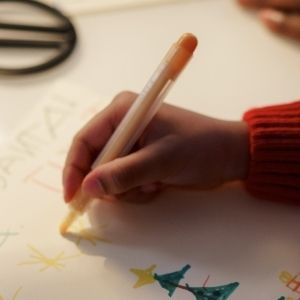
If your child is struggling with their handwriting, consider a special pencil designed to help kids develop their fine motor muscles. Here are some characteristics to look for in a good handwriting pencil:
- Wider body: Wider pencils are easier to grip. These are especially helpful for younger kids who are still developing their fine motor muscles. Make sure you have a pencil sharpener with a wider opening too!
- Triangular shape: Pencils with a triangle shape help to encourage children to use a correct tripod pencil grip. These can be a great alternative to pencil grips. And, they don’t roll off the table!
- Built-in grip: Some OTs swear by these pencils that have a grip texture built right into the pencil itself!
Make sure you also have a good eraser available, so your child will feel comfortable making mistakes!
Check your child’s desk and chair
When children are working on improving their handwriting, it is critical that they are sitting at a desk or table and in a chair that is the right size and height. This will allow them to work for longer periods of time before their muscles get tired.
The top of the table or desk should be about 1-2 inches above your child’s elbows when they are sitting in their chair.
When your child is sitting in their chair, they should be able to rest their feet comfortably on the floor. Their ankles, knees, and hips should all form 90-degree angles.
Related Post: How to Set Up Your Homeschool Room
Improve handwriting with lined paper
One of the easiest ways to improve handwriting for children is to use the correct lined paper. The lines show kids where to place their letters on the page. This helps with letter sizing and spacing issues, too.
- Lined handwriting paper: This paper has 3 lines to show where the top, middle, and bottom of each letter should be. Sometimes the top and bottom lines are solid while the middle line is dashed. Other times the bottom line is red and the top 2 lines are blue. The paper is usually named for the width from the top to the bottom line. 1/2 inch ruled paper, for example, has 1/2 inch between each of the top and bottom lines.
- Handwriting without tears paper: This kind of paper is unique to the Handwriting Without Tears curriculum for handwriting. It has 2 lines instead of 3, which makes it easier for kids to see.
- Raised line paper: Some handwriting paper even comes with raised lines so kids can feel where the letter should go! This can be a great way to give children a tactile clue for putting their letters in the right place.
Try some fun handwriting sheets
Make practicing handwriting fun with the right handwriting sheets! Fun copywork activities can be a great way to practice, and drawing or dot to dot printables can make practice fun.
You can also encourage your child to draw and write with activities, like these picture frame drawing prompts.

3. Improve Children’s Handwriting with a Tripod Pencil Grip
When your child holds their pencil, the correct pencil grip is called a tripod grip. In a tripod grip:
- The child uses 3 fingers: their thumb, index, and middle fingers.
- The pencil is pinched between the thumb and index finger.
- The thumb is bent.
- The index finger points toward the tip of the pencil.
- The pencil rests on the side of the middle finger.
Ideally, your child should be using the correct tripod grasp to hold their pencil by age 6.
You can watch a video of different pencil grips here.
Tricks to improve pencil grip for children
If your child is using more than just 3 fingers in their pencil grip, you can ask them to hold a cotton ball with their other fingers while holding their pencil.
You can also try using a pencil grip to help your child learn the correct tripod grasp for their pencil. Pencil grips are an easy way to solve the problem, but it can be tricky to take the pencil grip away once a child gets comfortable using it. Some pencil grips can also prevent children from developing the fine motor strength they need to hold their pencil correctly.
Just relax!
Another trick that can help improve handwriting for children is to help your child relax their grip on the pencil. Many kids tend to grasp the pencil with a lot of pressure and push the pencil hard into the paper. In addition to being stressful, this can cause a lot of muscle fatigue for kids. Encourage your child to relax, and not to press so hard, to fix this problem.
Build fine motor muscles
One of the best ways to improve handwriting for children can be to help kids develop hand strength in the fine motor muscles in their hands. And the great news is that there are lots of fun ways to do this, like using DIY sewing cards, that don’t involve writing at all!
Anything that requires finger coordination and dexterity can help build fine motor muscles. Fine motor activities to try include playing with playdough, cutting and gluing, using push pin poke art, coloring, stringing beads, playing games, and playing with blocks. These cut and paste activities for preschoolers are a great starting place.

4. Improve Handwriting with Correct Letter Formation
Another key to helping kids improve their handwriting is to make sure that they are forming their letters correctly. It is really hard to write with good handwriting when you are not forming the letters consistently and correctly!
Here are some tricks for practicing letter formation.
Practice letters in order by their shape
When kids are learning handwriting, it is important NOT to teach the letters in alphabetical order.
Instead, you should teach the letters in groups by how they are formed. For example, teach the lowercase letters c, o, a, g, d, and q together because they are all formed by starting with the same basic shape (the “c” shape).
This one trick can help kids understand how letters are formed more quickly and easily. It can also help prevent letter reversals (b and d, for example) because children are focusing on how the letters are formed from the beginning.
Make up a handwriting rhyme
Simple rhymes can help kids remember how to form the letters. Many handwriting curricula will include helpful rhymes and memory tricks as children are learning new letters to help them remember. If yours doesn’t include this, you can make up your own tricks to help your child.

Improve handwriting by paying attention to letter size
Make sure that your child is paying attention to where the letters fall on the paper. Which letters have tails that go below the bottom line? Which letters reach all the way up to the top line, and which ones stop at the middle line?
It can also help to teach all the capital letters first. Wait until your child has mastered all the capital letters and can form them all correctly on a consistent basis before moving on to lowercase letters.
Use the senses
Another trick to help improve handwriting for children is to create opportunities to practice that involve all the senses.
Kids can write their letters in a tray of shaving cream, with their fingers on a piece of sandpaper, with chalk on a large chalkboard, or in a sandbox.
These kinds of activities are a fun way for children to practice forming their letters correctly in a different context. This can help them remember better, and give them an opportunity to practice without getting frustrated.

5. Improve Copying and Spacing Words
Sometimes, children can write individual letters but struggle to copy words or sentences. This can be frustrating, but here are a few tricks that can help.
Slow down
Sometimes, the cause for a child’s handwriting problems is just that they are trying to write too quickly. Encouraging those children to slow down may be all it takes to help them have better handwriting.
Say each letter out loud
If your child is struggling to slow down, or to concentrate, a good trick can be to ask them to say each letter out loud as they write it. This can help keep kids focused on the letter that they are writing.
Use a finger for spacing
Many kids struggle with remembering to put a space between each word. The words run together which makes it hard to read what they have written.
A good trick is to ask your child to use their finger to skip a space. They can put their finger down on the paper next to the last letter in their word. Then, they should hold the finger there while writing the first letter of the next word next to it. This helps them remember to leave a space between the words.
Bonus: Make it Positive and Fun
No matter what your child’s handwriting struggles may be, one of the most important things to remember is to stay positive and make practicing fun. Take time to encourage your child regularly and to celebrate the progress they are making.
Also, make sure that you take lots of breaks while practicing handwriting. Improving handwriting for children is like exercise. Kids are working new muscles in their hands, and they will become tired and need a break after a while.
It is also important to remember that some kids may choose to write illegibly on purpose if they have low self-esteem. Bad handwriting is one way to cover up other mistakes, like spelling for example. If you can’t read what they have written, how will you know if they spelled the word correctly?

What if it isn’t working?
What if you have tried everything that you can think of, followed all the tips for a child who hates writing, and your child’s handwriting isn’t improving?
Take a break
Sometimes, it takes time for your child’s fine motor skills to catch up with their skills in other areas. Children develop different skills at different rates, and that is ok.
Especially if your child is young, consider being their scribe. Can you write the answers down for them on a math worksheet, for example? This will help your child be able to progress in other subjects without needing to be able to write down the answers.
You might also choose to teach your child how to type and allow them to type certain assignments. This is a practical way that many adults compensate for bad handwriting.
Seek out more help to improve handwriting
If you are concerned about your child’s handwriting and fine motor skill development, please consider seeking help from a trained Occupational Therapist. A good OT can check to see if your child’s challenges are a problem, as sometimes other conditions like dyslexia can affect handwriting. An OT can also recommend next steps to help improve handwriting for children.
You Might Like…
Transportation Multi-Level Handwriting Pack

Perfect for multiple ages!
Make handwriting fun and easy with this 60+ page transportation-themed pack! 3 different levels are included so kids of all ages can work together. No prep is required- just print and go!