
Handwriting Without Tears Practice Sheets (Free PDF for Homeschool)
My family loves using the Handwriting Without Tears program in our homeschool. But, we have found that we need more practice than the books provide. I started writing out additional words for my son to practice on handwriting paper, but I was constantly wishing for something better. So, here are some free Handwriting Without Tears practice sheets in PDF format that you can download to use in your homeschool- and tips for how to use them!

I only recommend products that I use and that we love. This post may contain affiliate links and I may earn a small commission for purchases made through those links.

Why Practicing Handwriting is Important
Handwriting is a crucial skill for all students to learn. However, practicing handwriting has gone out of favor in education recently. Here are some reasons why it is important for your child to learn to write with good handwriting, even in a tech-focused world.
Handwriting Practice Helps Kids Communicate
The reality is that no matter how much technology our world has, it is still helpful to be able to communicate in writing from time to time. Children need to know how to be able to write themselves a note. A handwritten thank-you note is still a great follow-up to a job interview, or a present from a relative.
By practicing handwriting with copywork, children are exposed to great works of literature. This can help to improve writing skills as well, as kids copy the style of famous authors.
Good Handwriting is Helpful for Spelling and Reading
Kids who can read what they have written will have an easier time knowing if they spelled the words correctly. This means that handwriting practice, when done correctly, can also help reinforce spelling for kids.
In addition, when children are using correct spelling they will begin to see connections between the letters that they are writing and the sounds that those letters make within the word. This can help with reading skills as well.
Practicing Handwriting Helps with Learning in Other Subjects
Research shows that having good handwriting is helpful for learning in almost every other subject area. Kids who can write quickly and easily will have a much easier time taking notes on what they are learning or completing written assignments.
Good handwriting can even be helpful in a subject like math that doesn’t use words. Kids who can write numbers neatly and organize them in rows and columns will have a much easier time completing complicated math problems.
Lack of Handwriting Skill can be Frustrating
One of the biggest reasons to use handwriting practice sheets in your homeschool is that struggles with handwriting are often contagious, leading to frustration in other subjects and with school in general.
Kids who struggle with handwriting often get frustrated when they know the answers but can’t communicate what they know through their writing. This can lead to resistance from kids and homeschool burnout for families.
Kids who struggle with handwriting will also have a hard time working independently in any subject area. They may need an adult to sit with them and write down the answers to questions they can solve on their own.
At What Age Should a Child Use Handwriting Practice Sheets?
Handwriting is an important skill for students, even at a young age, so it is ok for kids to begin practicing when they are young.
Most kids should be able to hold a pencil with the correct pencil grip sometime between age 4 and 6. This means that it is especially important for younger kids to develop their fine motor muscles with activities like playdough, cutting and gluing, stringing beads, or playing with blocks. This will help them develop the muscles necessary to hold a pencil correctly.
Fun and age-appropriate practice sheets will help kids develop handwriting skills that will help them in learning other subjects, too. No matter what age your child is, it is important to make handwriting practice fun and attainable for your child’s age and maturity level.

Which Handwriting Skills Should My Child Practice?
Good handwriting is made up of several components. Kids should work through each of these components in order as they are learning handwriting.
1. Pencil Grip
The foundation of good handwriting is the correct pencil grip. By age 6, kids should be holding their pencil with a tripod, or three finger, pencil grasp. If your child is not using the correct pencil grip, this is the first thing to correct when practicing handwriting.
2. Letter Formation
It is critical that children learn to form their letters correctly. This means that they are writing with the correct strokes, in the right direction, and in the right order.
Many handwriting practice sheets will include arrows, numbers, or other hints to help kids remember how to form the letters. However, it is important to watch your child forming their letters and make sure that they are following the correct letter formation.
3. Writing Legibly: Pencil Control
Once kids learn how to form their letters, the next step is to give them a lot of practice. This will help them learn to control their pencil and make their letters consistent.
This step takes time and practice to develop. Extra handwriting practice sheets can help to reinforce what students are learning in their handwriting curriculum.
4. Letter Sizing
It is important that children pay attention to where their letters fall on the lines. Are the tall letters touching, but not crossing, the top line? Are the tails of the letters hanging down below the bottom line?
The Handwriting Without Tears program is unique in that is only uses 2 lines, instead of the usual 3. This can make it easier for kids who struggle with the number of lines on traditional handwriting paper. However, students who are used to using Handwriting Without Tears paper should use handwriting practice sheets that have 2-line paper as well.
You can learn more about the Handwriting Without Tears program in my Handwriting Without Tears Preschool Curriculum Review.
5. Letter Spacing
Another important consideration for writing legibly is the spacing between letters and words. Kids need practice to learn how to space the letters in a word close together, but not touching.
Children also need to learn how to leave space between words. This is usually not intuitive for kids when they first learn to write. It can help to teach them to put a finger on their paper where they need to leave a space. This can help them judge how much space to leave between words.
6. Efficiency
Over time, as children continue to practice handwriting, they will learn to write more quickly and easily. This efficiency will help them be able to use their handwriting skills when learning a variety of different subjects.
If you are struggling to teach any of these skills in your homeschool, check out my post on how to improve handwriting for children for more advice and tips.
What to Look for in Handwriting Practice Sheets
Choosing the right handwriting practice sheets is important to make handwriting practice helpful and fun. Here are some things to look for when choosing handwriting practice sheets for your child.
Capital or Lowercase, Printing or Cursive?
First, it is important to look for printables that focus on the kind of letters your child is learning. Most kids learn to print capital letters first, then lowercase letters, and finally to write in cursive. Kids usually spend a year or two working on each of these skills before moving on to the next one.
Make sure the handwriting practice sheets that you choose focus on the kinds of letters, and even the specific letters that your child is learning.
What Kind of Lines?
Handwriting practice sheets should include guide lines so children know where to put their letters. Traditional handwriting programs usually use a 3-line system to show where the top, middle, and bottom of each letter should be.
The Handwriting Without Tears program uses a 2-line system that eliminates the top line to make it easier for kids to see where letters should go.
Your handwriting practice sheets should use the same kind of lines that your child is used to seeing in their handwriting curriculum. Consistency will help kids practice without getting confused or frustrated.
Reinforcement for Forming Letters Correctly
It is important that when kids are practicing handwriting, they are forming their letters correctly each time they write them. Practice is only helpful if kids are practicing correctly.
The common saying is that “practice makes perfect,” but a better saying is that “perfect practice makes progress.” Practicing forming letters incorrectly won’t help your child. In fact, it will cement bad habits and make it harder for your child to learn to write correctly.
Look for handwriting practice sheets that reinforce how to form new letters with arrows, numbers, or other helpful hints.
Is it Fun?
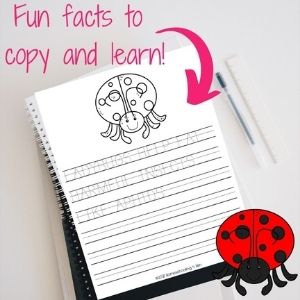
It is also important to make sure that handwriting practice is fun for your child. Kids will be more likely to want to practice if they enjoy doing so. Look for themed practice sheets or worksheets with fun facts to copy. This will help kids enjoy their handwriting practice more.

How to Use Handwriting Practice Sheets
Here are some tips to help you get the most out of your PDF Handwriting Practice Sheets!
Use a Laminator
The best way to get the most out of your printables is to laminate the pages. Pages that are laminated will hold up better to repeated use by multiple kids. In addition, your child can write on laminated pages with a dry erase marker.
If you don’t have one yet, a single sheet laminator is a fantastic investment for your homeschool. You will save the money that you spend on a laminator many times over as it will allow you to re-use consumable resources!
If you don’t want to invest in a laminator, you can also slip individual practice sheets into a plastic page protector sleeve to get the same result.
Focus on Quality over Quantity
When kids are using handwriting practice sheets, it is important to focus on quality over quantity. Make sure that your child is doing only as much handwriting as they can do carefully and well. If that’s only one page, or even part of a page, it is better to practice less with correct letter formation.
Sometimes, when kids have too much to do, they get overwhelmed and just try to “get it done” rather than doing their best work. Avoid this by asking your child to do less.
Free PDF Download: Handwriting Without Tears Practice Sheets for Your Homeschool!
This bug-themed multi-level handwriting practice sheet pack includes both 3-line and 2-line Handwriting Without Tears style practice pages for both capital and lowercase letters. Enjoy handwriting practice with your kids this spring with this fun resource!





Thanks for the info!
I’m so glad this was helpful, Kacie!