The Reading Game Review
Lately, my family has been enjoying playing The Reading Game, 2nd Edition from Allsaid & Dunn LLC. This game is a fun way for kids to learn new sight words and build confidence with reading through systematic activities. In this Reading Game review, I’ll share what made this game a good fit for our family, and how we are using it in our homeschool.
I received The Reading Game in exchange for my honest review, but all the opinions in this post are my own.
What is The Reading Game?
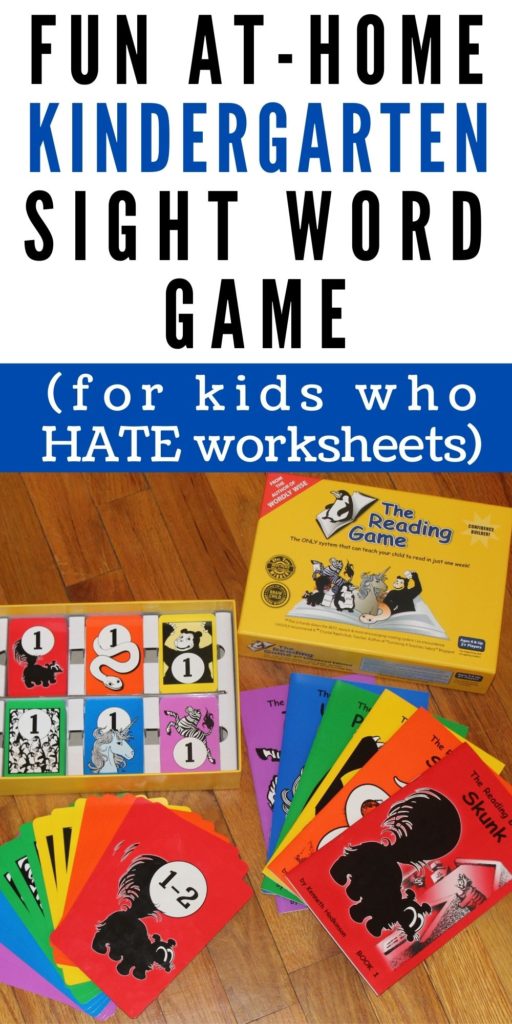
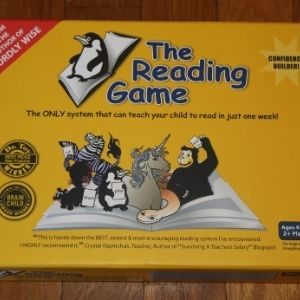
Contrary to the title of the product, The Reading Game is actually much more than a game. This is a whole system for teaching kids to learn 180 new sight words. The Reading Game includes 6 sets of 60 matching cards, 18 story flashcards, and six 32-page readers that incorporate the words that kids are learning.
On the box, the game says that it is designed for ages 4 and up. To play the game, kids should be able to recognize both uppercase and lowercase letters. They also need to be able to match uppercase and lowercase letters that are the same. Kids should also have a basic understanding of the idea that different letters make different sounds.
The game can be played with 2 or more players. In a homeschool setting, this would probably be a parent and a child. There are parts of the game that could be played by two or more kids if you are trying to teach multiple kids how to read. The game is also simple enough that an older child could play with a younger child to help reinforce their reading skills.
Because each of the activities is short, this game could be played in just a few minutes per day. For best results, you should plan to use the game at least several times per week over the course of several weeks.
The Reading Game was written and created by Kenneth Hodkinson, who is also the creator of the popular Wordly Wise vocabulary curriculum.
How to Play The Reading Game
Playing The Reading Game is simple. Kids progress through 3 different steps that build sequentially upon each other.
1. Play the Matching Game
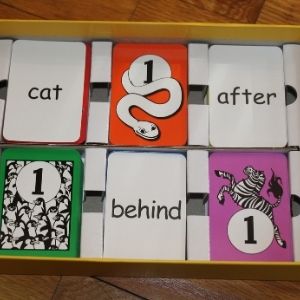
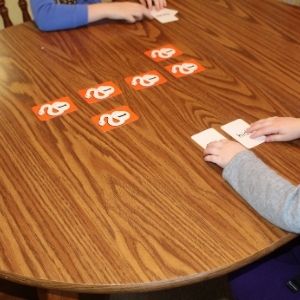
Kids’ first introduction to new sight words comes from playing matching games. The decks of cards are divided into sets of five words. To play, you just shuffle the word cards and spread them out face down. Kids turn over the cards two at a time, and if the words match, they get to keep the cards.
My kids loved this part of the game. The matching games were quick and easy since there were only ten cards and five total matches per game. I liked that the games were simple to play- which meant no fighting over the rules. The short games even held the attention of my toddler, who was playing along while her brother practiced his reading. I was surprised to learn during our Reading Game review that she could look at the pairs of cards and tell if they were a match or not, even though she couldn’t read the words!
The directions suggest asking kids to read the words out loud when they find a match, and repeating the game until kids can read all the words without hesitation. We decided that we would read all the words whether or not they were a match, which helped my kids learn the new words even more quickly.
2. Read the Story Card
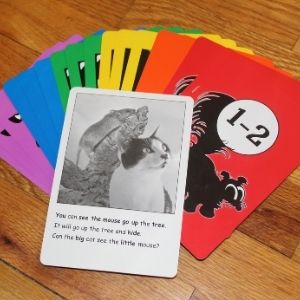
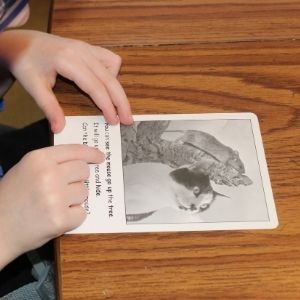
After completing two sets of matching cards and learning a total of ten new sight words, the Reading Game includes a story card for kids to read. These are large flashcards that include a black and white photograph and a caption. The captions include the new words that kids have learned in the matching game.
We found that the story cards were a great way to review the new sight words. They also served as a transition between reading single words on the cards and reading an entire story.
3. Read the Reader
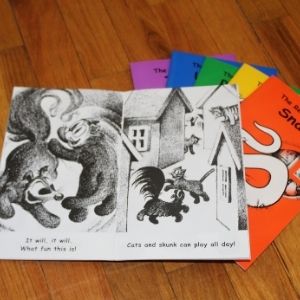
After completing a total of six sets of matching cards and three story cards, kids are ready to read the reader. The Reading Game comes with six readers that go with each of the six levels. The readers are 32 pages long and include all the words from the matching cards, plus a review of words from previous levels.
The stories were my kids’ favorite part of our Reading Game review. We found that the stories have a lot more plot in them compared to the average beginning reader. Each of the stories tells about the animal that’s on the cover, so the stories were fun and relatable to my kids.
After completing six levels of matching game, story cards, and readers, kids will know 180 sight words.
Whole Language vs. Phonics in our Reading Game Review
We discovered quickly in our Reading Game review that The Reading Game uses a whole language approach to teaching kids how to read. This means that kids are looking at whole words and memorizing them to learn how to read.
The alternative to a whole language approach in learning how to read is for kids to study phonics. When they learn to read with phonics, they learn the sounds that individual letters make. By blending the sounds, they can learn to “sound out” new words.
Research suggests that using a blend of both methods is really effective in teaching reading to kids. Because of this, I was happy to see that The Reading Game also includes suggestions for how to incorporate phonics into the game. The Rules and Guide suggests adding a phonics lesson at the end of each level. The game includes a chart that shows how parents can sort the cards from each level into groups phonetically. Then, kids can try to think of other words that would fit into the group.
We took this suggestion a step farther in our homeschool. After we explored the different groups of words, I made some more word cards that included other words in the category. Then, my kids practiced applying the phonics rules they had learned to read the new words.
Although this game is designed as a stand-alone reading program, I think it would also be great to use in combination with a separate phonics-based reading program.
Pros of The Reading Game
The reading game is a great option for families who are teaching a child to read. It will be an especially good option for families who enjoy gameschooling as well. Here are some of my favorite things about this fun game.
1. The Reading Game is well made.
One of the first things we noticed during our Reading Game review was the quality of this game. The box is sturdy and the cards are thick. The game seems like it will stand up to a lot of play time, even with young children.
2. Everything is organized and labeled.
Each of the levels of the game is color-coded with a bright color and labeled with an animal. In addition, the matching cards and story cards are clearly numbered. This helps keep everything organized and makes it easy to find the materials you need. I love that the box has an insert that keeps the cards organized by level- even when the box is tipped upside down!
3. The animals make the game fun.
My kids loved that each of the levels was labeled with a different animal (skunk, snake, bear, penguins, unicorn, and zebra). The animals are printed on the backs of all the cards. The stories at the end of each level are about the animals. My kids were very motivated to work through the cards because they wanted to read each animal’s story.
4. The Reading Game is systematic.
As we played the Reading Game during our Reading Game review, I loved how sequential the system was. Kids work methodically through the matching games, story cards, and readers. Once we figured out the system, even my kids knew what step should come next.
The organization of the game was helpful because each activity builds intentionally on the previous one. Kids move from reading words to reading sentences to reading stories gradually. This means that no one is going to get left behind or frustrated that they can’t do it!
5. The game incorporates review.
I love that review is built right into this game! The story cards and readers are designed intentionally to include a review of words from previous levels. In addition, the Rules and Guide for the game suggests that families practice each step over and over until kids master it. The systematic review in this game means that kids will actually be learning and remembering the new words, instead of just memorizing them and then forgetting them.
6. Opportunities for assessment are included.
Each level of The Reading Game includes three different story cards. These story cards are the perfect way to see if your child has learned the words in the matching game. Kids see the new words in a different context, within a sentence. If they can read the story card, this is a good sign that they know the words and are ready to move on. If not, kids can repeat the matching games for review.
7. The website includes extra resources.
As part of our Reading Game review, we also had the chance to check out the website. There we found a Pre and Post Sight Word Assessment document that will be helpful for homeschool families. This is a checklist that goes along with each level of the Reading Game. Parents can record how many of the words their kids can read before completing the level, and again after finishing it. This document will be perfect for record-keeping in a homeschool portfolio.
8. The Reading Game moves fast.
Each of the activities only takes a few minutes to do. This made it easy for us to pick up the game when we had a few minutes of free time, and to stop when we needed to. It also helped my kids stay engaged in the game, even with short attention spans.
9. The game is motivating.
I love that motivation is built right into The Reading Game. During the matching games, my kids were motivated to try to win each round. In addition, they wanted to keep playing the matching games so they could earn the story cards or readers.
Cons of The Reading Game
One improvement that I would like to see to The Reading Game is in the illustrations. Both the pictures on the story cards and the illustrations in the readers were in black and white. The backs of the cards and the covers of the books are so brightly colored. I think that the game would be even better and more motivating to kids if the illustrations were in color as well. This didn’t detract from our experience playing the game, and I would definitely still recommend the game even with black and white illustrations.
All in all, my family loved playing The Reading Game. I would definitely recommend this resource to anyone who is teaching their child how to read!
Are you interested in trying the Reading Game with your kids? The Homeschool Review Crew will be giving away FIVE copies of the game! Head over to the Homeschool Review Crew Blog to enter the giveaway and read more reviews!

Check out my other curriculum reviews here!
Learn more about gameschooling here!