
Getting Started with Singapore Math
We recently started using Singapore Math in our homeschool. We love the content of the curriculum but the learning curve has been steep to get started. Here’s what I wish I would have known when we were starting out:
I only recommend products that I use and that we love. This post contains affiliate links and I may earn a small commission when you click on the links. There is no additional cost to you and you are supporting my family as I help others homeschool with confidence. Thank you!

What is Singapore Math?
Singapore Math is a curriculum that was developed by the government of Singapore for use in its public schools in the 1980s. This method teaches problem solving and thinking skills and teaches kids to draw pictures to solve problems. The curriculum has been translated and is used by both traditional and homeschooled students.
What makes Singapore Math Unique?
- Singapore math covers fewer topics, but in greater depth, than some other curricula. The topics are divided into units, but the same topics are repeated each semester or each year so review is built into the program as well.
- Number bonds- Singapore math teaches kids the relationships between numbers in an addition or subtraction problem using a picture called a number bond. (This concept is also called a Fact Family in some other curricula.)
- Bar models- Singapore math teaches kids to draw pictures, called bar models, to solve word problems. These pictures help introduce algebra concepts at a young age as kids begin to look for the unknown in a problem.
Concrete – Pictorial – Abstract Approach
This learning theory is the foundation for how Singapore Math is structured and taught. It says that when kids learn a new concept, they learn best when it is taught in 3 steps:
- Concrete: Kids learn a new concept first by representing it with objects. This could be special math manipulatives, or it could be objects that they have around the house. For example, when teaching kids to add, they should make 2 piles of cheerios, push the piles together, and count the total- this is adding.
- Pictorial: In the next stage, kids take the same concepts that they learned with objects and represent them with pictures instead. The textbooks and workbooks have lots of practice problems for this step. In our addition example, kids might look at a picture of the 2 piles of objects and add them together by counting the objects in the picture.
- Abstract: After kids have had lots of practice solving problems with concrete objects and pictures, they will be ready to do the math “in their head” and solve the problem abstractly.

Singapore Math Programs
The original program that was developed in the 1980s, and is still used today, is called Primary Mathematics. This curriculum is available for grades 1-6. There are 3 different editions of this curriculum. They all use a similar method, but the topics covered in each are slightly different:
- Primary Mathematics U.S. Edition (or, just “Primary Mathematics”): This is the O.G. curriculum from Singapore. The units of measurement and the currency have been changed but almost everything else is the same.
- Primary Mathematics Standards Edition: This edition was written for use in the public schools in California. The content of the U.S. edition was edited to meet the California state standards in 2006 so the book could be used in the public schools there. Topics added include probability, coordinate graphs, and negative numbers.
- Primary Mathematics Common Core Edition: This edition was written for use in the U.S. public schools so that it aligns with the Common Core standards.
You can download a comparison chart for which editions cover which topics.
Important Tip:
Once you choose an edition it is very important to stick with that edition and to make sure that all the books and resources that you buy match the edition that you have chosen. There are many resources available and it is easy to get confused!
Dimensions Math
Dimensions math is a relatively new Singapore Math program for preschool through 8th grade students. This program is designed and marketed for use in school classrooms but also works for homeschool. The program is an updated version of the Singapore Math curriculum. Its lessons are longer and more in-depth, with more hands-on math review activities, and all the extra resources are built into the text.
What Books Do I Need?
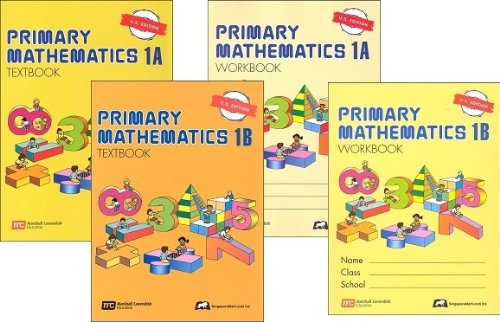
For Primary Math, you will need at least 3 books for each level:
- The textbook: This is not like a traditional textbook. The Singapore Math textbooks are more like a full color workbook, with limited explanations of concepts and practice problems included. The textbook is designed to work with and reinforce the lessons that are being taught by the teacher, and kids will not be able to read it independently and teach themselves. It is designed to be consumable, with spaces in the book to write answers.
- The workbook: This is a black and white version, with more practice problems and even less explanations. It is also consumable.
- The home instructor’s guide: This book is like the decoder key for the textbook, that explains what is actually being taught and why it is important in the program as a whole. It also shows how the textbook and workbook work together. This book is really critical to have, especially if you are new to the Singapore Math program.
Each of these books covers half of a school year, and is labeled with a number and a letter. To cover a complete school year, you will need the “A” and “B” books of each level. For example, the 1A books are for the first half of first grade, and the 1B books are for the second half of the first grade year. So, if you’re keeping track, that’s 6 math books to buy for first grade.
The Dimensions program also has a textbook, workbook, and teacher’s guide for each level. There is also a test book available for Dimensions.
Extra Practice Books
There are several different supplement books available for each level of the Singapore Math curriculum.
- Intensive Practice: These books have extra practice problems, more challenging problems, and word problems that correspond with each unit in the U.S. Editions. These books are a great addition to the Singapore Math program.
- Challenging Word Problems: These books have extra word problems to practice, along with example problems with solutions. They are an excellent resource for teaching kids how to solve word problems, and for reinforcing the thinking skills that the Singapore Math program is known for. There is one book available for each grade level (so no “A” and “B” here) and they correlate with the Common Core Edition (although they can be used with any of the editions).
- Extra Practice: These books just have more of the same kinds of problems that the workbooks do. We don’t use this book but it would be helpful if your child struggles in math and needs lots of review to master new concepts. Keep in mind that the extra practice and the intensive practice books are different!

Pros and Cons of Singapore Math
Pros:
- This is one of the most rigorous math curriculums available to homeschool families.
- There are a wide variety of practice books to customize the program to the right difficulty level for your unique child.
- This program teaches thinking and problem solving skills, not just memorizing.
Cons:
- This program is very teacher-intensive. Lots of hands on time is required to teach the lessons, especially for younger kids, and some prep work is also required to figure out how the different books and supplements should be used together.
- If Singapore Math is not the way that you learned math as a child, it can be challenging to figure out how to understand the topics, and be able to teach them.
Singapore Math Live
The Singapore Math Live program is available to support families who are using the Primary Mathematics U.S. Edition program. Brenda Barnett has produced videos teaching the lessons and working through solutions for many of the problems. This is a good alternative for parents who like the concepts covered in the curriculum, but are struggling to figure out how to actually teach this curriculum to their kids.
Do you use Singapore Math? What do you think about it?



I like that their is a large variety of books and it teaches thinking ands problem solving skills.
I will share with my sister, she is a math teacher. I am sure she will get some ideas.
Where was this when my kids were little?!
this sounds like an awesome resource for homeschoolers!!
Singapore math is so fun and great for kids to learn!
Hi Jasmine! It’s a really great curriculum for sure!
Yes! My kids really enjoy it!
Hi Ashley! I agree! The variety of books are so helpful so that it can be personalized for each child’s needs.
Hi Alyssa! Singapore math has been around for a while, but I’m glad that it’s gaining popularity and more families are learning about it!
Hi Marjie! Awesome, I hope it helps!
Thanks for these recommendations. They are great resource for schools going children, excellent work!
Singapore Math looks a little like the way they’re teaching Common Core nowadays.
Since we have family in Singapore and talked to them about school, I know I love this.. And we did attempt to get books for the kids while in elementary school to practice..
Hi Puja! Glad it helped!
Hi Tia! It’s definitely different than how I learned as a kid. I love that my son is learning how to think about math and solve problems though!
It sounds interesting to cover fewer topics but more in depth.
Hi Sarah! I think this helps kids remember what they have learned because we are spending more time working on it.
This was a very helpful review, thank you! I’m wondering if you purchased any manipulatives (I’m thinking of doing 1A&1B) or what manipulatives I should buy vs what i can just kinda make with things around the house?
Hi Karen! We are just finishing 1A and 1B this year. You can definitely do a lot with materials you already have. I would recommend purchasing a couple of things to start and then adding to your collection of manipulatives gradually as the need arises. I wrote about what I would recommend here: https://homeschooling4him.com/list-of-math-manipulatives/