Cartoons and Comic Books for Building Readers
In homeschooling, using cartoons and comic books for building readers can be valuable tool. These resources can help kids learn to read and develop important reading skills. They are also great for encouraging reluctant readers. To learn how to use these tools in your homeschool, keep reading.

Teaching your kids to read can seem like a serious and overwhelming task, but in my experience, it doesn’t have to be a chore to teach your kids to read. We know of very few adults that have left home without this important skill. At my house, two of my young readers nearly taught themselves! I had an experienced homeschool mom of five once tell me when her kids can read Calvin and Hobbes comics independently, that is when she considers them to be fluent readers. I was taken back at first, but the more I thought about it, it made sense. There is a lot of value in reading graphic-heavy books, especially as we teach our kids to read.
The Sunday Funnies or graphic novels are great places to start. At our house, Pooch Cafe and Garfield are both popular. These books often have stories that take place over a few daily comics or only a page or two in their book form. As reading fluency grows, other longer-form graphic novels can be brought in to keep their interest as their skills build. More publishers are recognizing the helpful nature of graphic novels for early readers and are creating new titles with this in mind. Science Comics is a favorite non-fiction series at our house, and the Hilo series by Judd Winick is a fun fiction read.
Illustrations are Important
At what age did you start reading the Sunday Comics? There aren’t more than a few dozen words in most newspaper comics, but each of the comic panels tells a story. The sequential art in a comic strip is just as important to understanding the story as the words, and with emerging readers, the illustrations of comic strips provided needed context to help them decipher the words. An illustration in a picture book may represent several sentences of the story while a comic strip is just a single thought or moment.
Comic strips also help our young readers get used to reading from left to right to follow the story, another important building block to reading readiness. This is another reason why comic books are great potential tools for homeschooling a struggling reader and teaching reading skills and reading comprehension.
New Vocabulary Words
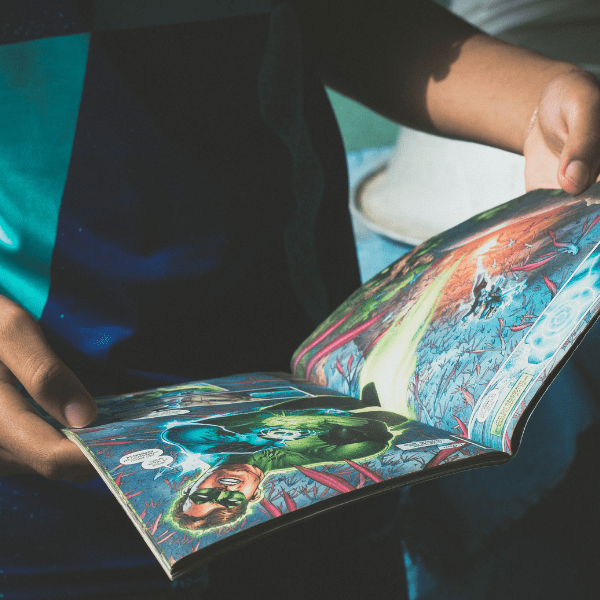
I hadn’t ever thought of the reading levels of comics until my friend explained her Calvin and Hobbes strategy to me. I went and looked up the reading level of Calvin and Hobbes, I was surprised to discover it was rated for an upper elementary reading level! When I went through the Calvin and Hobbes books we have on the shelf, there are some big words in there! Despite the stereotype of being a comic strip, it engages in some very thoughtful and profound philosophical and social situations.
In a comic there is less space than a picture book to convey an idea, so the words have to be chosen more carefully, and specific words are often used to convey meaning more precisely than a generic term. This makes reading comic books a great way to increase students’ vocabulary. Some even say Calvin is a gifted child so it is important his vocabulary matches his character.
Fewer Words on the Page
One of my readers is dyslexic so they needed extra help to get started learning to read and he needed fewer words on the page to feel comfortable reading. The small chunks of text found in the speech bubble of a comic or in long-form comic books are a great tool to give reluctant readers more confidence to read a denser narrative text. If I can read a 50-page comic book I can read a shorter book with fewer pictures. My dyslexic reader had a slower start to reading but when it clicked they caught up quickly to match their siblings. They still prefer to read picture books and graphic-heavy books over narrative structures like a traditional novel or a book with all text.

Interesting Stories
Our family loves stories and it’s an important part of our family culture. Dad reads bedtime stories every night and we listen to audiobooks on any trip we take in the car. My kids have grown up listening to great stories but when they were learning to read they were disinterested in the beginning readers available. They wanted to read the real stories like they heard every day at home. Presenting them with comics was a fantastic way for them to begin to read interesting stories sooner because the clear panel illustrations helped them fill in the meaning of the words they couldn’t read yet and helped them decode it.
My oldest was reading Calvin and Hobbes independently for a while and one day we were reading a sign that references the comic and they read it aloud to us for practice. We corrected them when they pronounced the E in Hobbes instead of letting it be silent. They continued to argue with us about how to say it. But we had never read it aloud with them, so they were pronouncing it wrong in the head for several months. Even with the wrong pronunciation they still understood that was the character’s name and the meaning because of the context of the story.
Look Beyond the Beginning Readers
Next time you are at the library with your emerging reader and they don’t like any of the learn-to-read books, take them to the comic book section or ask for the graphic novels and see if they can find something to catch their interest. If you want to be a little bit selfish you could even see if your favorite childhood comic has been published in book form to share with your kids. You might just enjoy listening to them read to you more when the story is more interesting as well!
Thank you to Cynthia Heren from Inside Our Normal for writing this guest post!

Cynthia Heren is a speaker, writer and homeschooling mom of 3 since 2014. With a variety of learning disabilities and other challenges across her 3 kids, her homeschool requires Outside the Box ideas. Normal at her house includes 2 trampolines, 5 sizes of pencils and indoor and outdoor swings, and a whole room full of LEGOs. She loves working one on one with other homeschool parents, encouraging them to create the perfect education plan for their Outside the Box kids. She also runs the Outside the Box Homeschool Community on Facebook where she hosts monthly workshops about homeschooling and Neurodiversity. You can find her at InsideOurNormal.com