Our Favorite Hands On Science Curriculum- Berean Builders Elementary Science in History
Both of my kids absolutely love science. They often beg to do a science lesson on weekends, and they are disappointed when it’s not science day in our homeschool. As a busy homeschool mom, science is not my strong point. I attribute 100% of our success in homeschool science to the series of books that we have been using for the past several years. Our favorite hands on science curriculum is Berean Builders Elementary Science in History. Keep reading to learn more about this amazing homeschool curriculum and how it can make science fun for kids in the elementary grades.

I received books from the Berean Builders Elementary Science in History series in exchange for my honest review, but all the opinions in this post are my own.
Hands on Science Curriculum from Berean Builders
Berean Builders offers homeschool science program options for kids from elementary through the high school years. The Berean Builders Elementary Science in History program is designed to help kids understand the history of famous scientists and scientific discoveries. Kids learn about science concepts in the order in which they were discovered over time.
Berean Builders also offers middle school science courses including Discovering Design with Earth Science. They offer high school courses that cover four full years of high school science. These include Discovering Design with Earth Science, Discovering Design with Biology, Discovering Design with Chemistry, and Exploring Creation with Physics.
Who is Dr. Jay Wile?
All of the textbooks in the Berean Builders science series are written by Dr. Jay Wile. Dr. Wile has a PhD in nuclear chemistry and has published more than 30 research articles. He is also a homeschool dad and has written 13 different science textbooks that are designed specifically for homeschool families.
Read more about Dr. Wile.
What books are included
The Elementary Science in History series includes 5 different textbooks that cover science from creation to the present.
Science in the Beginning: This is the first book in the series and it covers the days of creation. Over the course of the entire year, students will cover energy and light, states of matter, water and air, plants and animals, the human body, and more.
Science in the Ancient World: In this book, elementary school students study scientists who lived from 600 BC to 1500 AD. Kids learn a lot about the scientific process by studying both what scientists discovered that was correct, and also their incorrect discoveries. Kids learn about the scientific method and the importance of running experiments and observing the results.
Science in the Scientific Revolution: This is the third book in the elementary grade level series and it covers discoveries in the years 1543-1600. It covers a wide variety of topics and each lesson includes experiments and hands on science activities to help kids understand what they are learning.
Science in the Age of Reason: In this book, students learn about scientists from approximately 1600-1800. Topics covered include chemistry, geology, and weather.
Science in the Industrial Age: This is the final elementary leveled book in the Elementary Science in History series, and it covers approximately 1800-1900. This book also includes some interesting discussions about how the worldview of the scientist impacts the results of their work.
Science in the Atomic Age: This is an extension of the series for middle school students in 7th grade. It is a lab based course that covers 1900 to the present.

Helps and Hints Book
Each textbook in the series comes with an optional Helps and Hints book. These books serve as a teacher guide and include several resources to supplement what’s included in the textbook.
Hints for the Science Experiments:
Most of the science experiments are pretty straightforward and easy for kids to complete on their own, with minimal help. But the Helps and Hints book includes additional tips for success for some of the more difficult science experiments.
One of my favorite things about this curriculum is how easy the experiments are. I don’t want to have to go look up extra hints in the teacher’s guide in order for my kids to see the result we are looking for. But, every once in a while the Helps and Hints book has saved us when we weren’t getting the results we expected in the experiment.
Answers to the Questions:
All the answers to all the follow up questions for all the levels are provided in the Helps and Hints books. The younger kids questions are usually covered directly in the text, but it is nice to be able to reference the older kids answers in the instructor’s guide.
Tests and Answer Keys:
We are fortunate that our state does not require tests for homeschool families. Because of this, I have chosen not to give tests to my kids as a part of our homeschool. But, if you would like to give tests as a part of your homeschool science lessons, the Helps and Hints book includes tests, each of which covers about 5 lessons. And, each test has an answer key included.
If you prefer not to give tests in your homeschool, the tests could also be used as activity sheets or for review after finishing the lessons.
Read more about choosing a science course.

Favorite Features of the Berean Builders Elementary Science in History Series
I am so grateful that we have found the Elementary Science in History series from Berean Builders! Here are a few of the reasons why we love this complete science curriculum.
Hands on Science Experiments
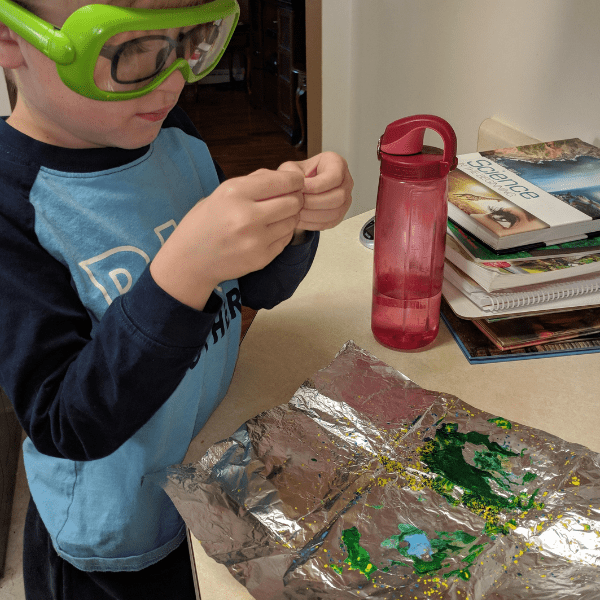
In my opinion, the best part about the Berean Builders Elementary Science books is definitely the science experiments. I love that every single lesson includes a science experiment built right in to the lesson.
Before we used Berean Builders for our science curriculum, I chose the traditional textbook approach. I promised myself that I would supplement our boring textbooks with some science experiments, and I even bought an experiment book. But, then life got busy and it was easy to just skip the experiments. There was a lot of prep work involved in finding the right experiments that would match each lesson. So it just didn’t happen.
I know that experiments are an important part of helping kids appreciate the wonders of science and making learning fun for kids. So I love that all the science experiments are included right in the lessons. All of the work of choosing and planning experiments is already done for me- I just need to open the book to the lesson and everything that we need to do is explained, usually with pictures too!

Common Household Supplies
After I started using our science experiment book, I quickly discovered another problem with many homeschool science curricula- they required us to gather lots of unusual or uncommon supplies in order to complete the experiment. There is no faster path to intimidation than seeing directions like these: “For this experiment, you will need a piece of heat sensitive paper, some dry ice, 3 feathers from a large bird, and a live earthworm.”
I absolutely love that the Berean Builders Elementary Science in History series makes gathering supplies for the experiments so easy. Almost all of the experiments use common household items that we already have in our home. Each experiment includes a supply list so we know what we need to gather in advance.
I also love that there is a complete list of all the supplies needed for the whole year at the beginning of the book. Supplies that are more unusual or that an average family might not have around the house are labeled, which makes it easy to gather science supplies in advance.
It is clear from how the experiments are designed that Dr. Wile is a homeschool parent who understands how to make science practical for homeschool families.
Download a supply list and other science resources for each book here.

Easy for Kids
Another thing I love about Berean Builders Elementary Science in History is how easy the experiments are for kids to complete. After lots of complicated science experiments that included steps for parents to do and kids to watch, I love that this curriculum includes simple experiments that are designed for kids to be able to complete them on their own.
Steps that require parent help or supervision are clearly labeled, but almost all of the steps can be easily completed by an elementary school aged student. This makes the curriculum a good fit for families that want to encourage their kids work independently.
Each experiment includes step by step instructions, so kids will understand exactly what they need to do. And the instructions include important steps like “clean up your mess” that are often left out of science experiments, but are critically important for kids who are working through the directions independently.

Science in the Context of History
I have looked at a lot of options for an elementary science education for my kids. As near as I can tell, there is not another curriculum out there that teaches about science in the context of history and scientific discoveries.
I love this perspective because I have been able to help my kids understand how the contributions of each different scientist affect people’s understanding of God’s creation. And, my kids have been learning that science is a process, and that sometimes our understanding of how the world works changes with new discoveries.
We have been able to learn a lot of life lessons about the importance of thinking critically about information that is presented as fact, and the value of standing up for what is true even when others don’t believe you.
I also love that these discussions are helping my kids see the role that Christianity has played in the field of science over time.
Read more about the benefits of a historical approach to science.
Variety of Topics
When I was a child in the public schools, my elementary science classes covered a variety of topics. We learned about physical science once week, animals the next, and the periodic table after that. So I was surprised to discover that many of the larger homeschool publishers teach the same branch of science for an entire year- even in elementary school.
I love the way that the Elementary Science in History series includes a wide variety of scientific concepts in every book. Because we are learning about science from the lens of history, we are studying all the discoveries that happened in a given time period, across all the branches of science.
I think this variety is a reason why science is one of my kids’ favorite subjects. The curriculum keeps moving, which keeps science interesting for my kids.
Biblical Worldview
As homeschool parents, it is crucial for my husband and me that any curriculum that we choose for our kids supports our Biblical worldview. The Elementary Science in History series makes it clear from the beginning of the first lesson that the purpose of studying science is to help us understand God’s creation.
I love that the entire first book cements this concept by studying science in the order of the days of creation. This is such a helpful way for kids to see the bigger picture of why they are studying.
I also love that individual lessons talk about the beliefs and worldviews of individual scientists, and how this impacted their work. This is an important discussion to have within the field of science. I love that I am able to help my kids think critically about how worldview plays a part in science.

Comprehensive
I love that this series goes into depth about each science topic covered. This curriculum is so much more advanced than the average elementary school science curriculum. The depth of understanding that my kids have developed about the natural world and about advanced science topics is impressive.
But, the curriculum is also written to take what can be an intimidating subject and break it down to make it easy to understand. The lessons are written directly to the student and are designed for older students to be able to read and complete independently.
Check out sample lessons from each book and other science resources here.
Great for Multiple Ages
Whenever I’m choosing a homeschool curriculum for my own family, I am always looking for a curriculum that can be adapted for multiple ages to use together. My kids are 3 years apart, so it is important that any curriculum that we use include different levels for different ages.
The Elementary Science in History series includes 3 different levels of questions at the end of each lesson.
The Youngest Students questions include just a couple of short answer questions that ask kids to remember something that they heard in the lesson.
The Older Students questions require a science journal and encourage kids to write or draw about what they are learning.
The Oldest Students questions go even more in depth, often asking kids to think critically and apply what they have learned to a new situation or develop a deeper understanding of the topic.
In our family, we read the lesson and do the experiment together as a group. Then, I ask my son to answer the Youngest Students questions out loud while his younger sister listens. This is a great way to make science a little bit more difficult for my son, while still allowing my younger daughter to participate.
Download printable notebooks for Older and Oldest students and other science resources here.
Affordable
I also love how affordable this resource is for homeschool families. To use the curriculum, families just need to purchase one non-consumable textbook. The Helps and Hints guide is optional but very affordable. And older students will probably want a notebook to use as a science journal.
Try it for Yourself
I am so glad that my family discovered the Elementary Science in History series from Berean Builders. This is my son’s favorite homeschool curriculum that he has ever used in any subject. I credit his love of science to the fun experiments and hands on lessons that make science come alive in our home. I know I have made the best choice in an elementary science curriculum for my family.
If you are looking for an elementary science curriculum that reinforces a Biblical worldview, I would highly recommend the Elementary Science in History series.
Click here to learn more about Elementary Science in History and get a copy for your family!