Homeschool Philosophies
One of the best things about homeschooling is that no two homeschools look exactly alike. There are a number of different homeschool philosophies and methods that families follow. This is great for homeschoolers because we have the freedom to choose a method that works best for us. However, families who are just getting started with homeschooling often struggle with the number of choices that are available to them.
I only recommend products that I use and that we love. This post contains affiliate links and I may earn a small commission when you click on the links. There is no additional cost to you and you are supporting my family as I help others homeschool with confidence. Thank you!
New homeschool families should take some time to learn about the different homeschool philosophies and choose a homeschool method that works best for them. This will help you limit the number of curriculum options that are available and focus on the curriculum choices that will be the best fits for your family, without wading through all the options. It will also give you a blueprint for how to structure your homeschool, and some additional clarity about your priorities as you begin homeschooling.
Traditional (School at Home) Homeschool Philosophies
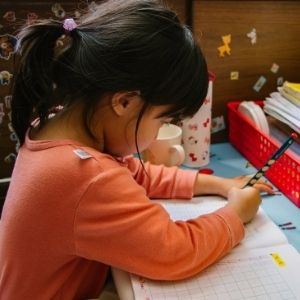
Traditional homeschoolers re-create the experience of a traditional public school at home. These families might use textbooks and workbooks as their curriculum. They might give tests to show what their kids have learned. They might set up a school room in their house with desks and a whiteboard.
This is often a more comfortable starting place for parents who come from a public school background, because they are doing what they know. And the structure can be really helpful for some kids and families. Traditional homeschool families also have access to a number of different open and go curricula, which can make homeschool planning really easy. Traditional homeschooling can be a good fit for families who are homeschooling temporarily and planning to transition back to traditional school in the future.
Pros
- Easy for parents to understand and teach because it looks like traditional school
- Easy to transition from traditional school to traditional homeschooling
- Lots of curriculum choices available
- Little planning and prep work required to teach lessons
- Ideal for visual learners
- Easy to follow state standards and keep kids on track with others in their grade
- Tests and quizzes show us what kids are learning
- Easy to transition back to traditional school if needed
Cons
- Can be expensive, depending on curriculum choices
- Often includes lots of busy work and worksheets
- Lessons can take a longer time to complete than those of other homeschool philosophies
- Can be frustrating for kids who don’t like desks and worksheets
- Kids’ frustration can lead to burn out for parents
- Especially difficult for kinesthetic learners
Traditional Homeschooling might be a good fit for your family if
- You went to traditional school and want to create an experience for your kids that looks like what you know
- You aren’t interested in learning a whole new way of teaching
- Your family needs to follow state standards of education
- You are homeschooling temporarily and plan for your kids to return to traditional school in the future
Curriculum and Resources:
Abeka, Handwriting Without Tears, Singapore Math

Public School at Home (Online School, Virtual Public School)
Although this isn’t technically homeschooling, it is worth mentioning as it is very popular right now. Public school at home is when families are educating their kids at home, using resources that are provided by a traditional public school. Homeschool families who aren’t using their local public schools may also choose to find an umbrella school for homeschoolers that provides a similar arrangement.
This is very different because in the public school at home model, the school chooses the curriculum, teaches lessons, assigns work, and gives grades. Unlike homeschooling, the primary teachers are not the child’s parents. This setup puts parents in the difficult position of having to carry out a lesson plan that they did not create.
Pros
- School oversight allows families to avoid most of the legal requirements that are in place for homeschoolers
- Parents do not need to plan lessons or choose curriculum
- This method often takes less time in the day than a learning in a traditional classroom setting would
Cons
- May not accommodate how your child learns best
- Often includes more screen time than the developmental recommendations
- Parents have to enforce a school plan they did not create
- When kids still see their teacher, and not their parent, as the school “expert,” it can be hard for some of them to listen to their parent as an authority in this area
- Challenging when kids struggle to stay motivated
- Can be hard for kids to seek help from their teacher when they don’t understand concepts
Public School at Home might be a good fit for your family if
- You are planning to homeschool temporarily and return to traditional school
- You don’t want to spend time planning lessons
- Your child is an independent and motivated learner
Classical Homeschool Philosophies
This type of homeschooling is based on the trivium, which was developed in the Middle Ages by Martianus Capella.
The trivium is a way of teaching kids how to think by using 3 main stages of development as a basis for their curriculum. In the Grammar stage, kids focus on memorizing and repeating facts in a wide variety of subjects. In the Dialectic stage, kids begin to ask questions and compare and contrast as they think logically about what they know. Finally comes the Rhetoric stage, where kids focus on communicating what they know through writing and speaking.
Kids using the classical homeschool philosophy do a lot of reading of major works of literature and memorizing of facts, especially in elementary school. They study logic and ancient languages as well.
Pros
- This method has been around for a long time
- The system is rigorous, and gives families lots of structure and guidance
- The stages of learning are based on child development
- Kids learn formal logic, critical thinking, persuasive writing, and ancient languages
- Kids read a wide variety of classic literature
- Through memorizing a lot of information, kids learn how to memorize
- Lots of curriculum options are available
- Support is available for families following Classical homeschool philosophies from active classical homeschooling groups
Cons
- There is lots of memorizing and reading, which can be discouraging for kids who don’t do those things easily
- Fewer opportunities for hands on learning
- Less focus on life skills, and more focus on ancient languages instead
- Lots of reading and memorizing leaves less time for math and science
- The structure is rigid and can be hard to adapt to each child’s learning style
Classical Homeschooling might be a good fit for your family if
- You want a structure that has proven success
- It is important for you that your kids study logic, ancient languages, and classic literature
- You want your kids to learn through discussion rather than worksheets and tests
Curriculum and Resources:
The Story of the World, The Well Trained Mind, Classical Conversations

Charlotte Mason Homeschool Methods
This method of homeschooling was created by Charlotte Mason, who was a British author and teacher in the late 1800s. Charlotte Mason homeschooling families focus on exposing kids to lots of high quality “living books” as textbooks, and spending lots of time outside in nature. Instead of taking tests, kids use narration or dictation or tell or write what they have learned. Lessons are short, and Charlotte Mason homeschoolers focus on developing good habits and learning through experiences.
Pros:
- Exposure to nature through intentional nature studies
- Kids experience classic literature through living books
- Focuses on life experiences and hands-on lessons
- Uses narration and dictation to assess what kids have learned without needing to give tests
- Short lessons keep kids engaged
- Has a Christian influence and focuses on building good habits and character
- Can be inexpensive if you use the library to find resources
Cons:
- Written for elementary aged kids, so less guidance is available for middle and high school aged students
- Because kids are following their interests instead of a curriculum, learning gaps can occur
- Requires lots of planning to make sure to teach concepts sequentially and avoid learning gaps
- Curricuum tends to be weak in math and science (other than nature studies)
Charlotte Mason Homeschooling might be a good fit for your family if
- You want to use living books instead of textbooks to teach your kids
- Your family enjoys spending time in nature and you want to pass your love of nature along to your child
- You like the idea of assessing your kids’ progress through discussion and journaling instead of tests
Curriculum and Resources
Ambleside Online, Simply Charlotte Mason
Unit Studies Homeschool Philosophies
In the unit study method, homeschool families focus all their curriculum and lessons around a specific topic that they study in great depth. A family doing a unit study about space might read stories about astronauts for a language lesson, calculate the distance between the planets for math, read about the history of space exploration, and even make a model of the solar system for a science lesson.
Unit studies tend to focus on hands on learning. They may be a great fit for families that teach kids of multiple ages together. Unit studies can also be combined with other homeschool philosophies. They work especially well with the Charlotte Mason, unschooling, and eclectic homeschool methods.
Pros
- Unit studies are often fun and motivating for kids
- Kids get to learn about topics that interest them
- Kids make connections between subjects easily
- Encourages kids to be creative and learn independently
- Allows kids of multiple ages to learn together
Cons
- Requires lots of time to plan and prepare lessons
- Often have to create your own curriculum from many different resources
- Kids often have gaps in learning since they aren’t following a sequential curriculum
Unit Studies might be a good fit for your family if
- You enjoy spending time planning and preparing creative lessons
- Your family includes multiple kids of different ages, who learn best with hands on activities
- You want to focus on helping your kids make connections between subjects
Curriclum and Resources
Unschooling Homeschool Methods
Unschooling is a term that was created by John Holt to describe and education that is different than what is offered in traditional schools. When families choose unschooling it does not mean that kids are not learning. Instead this is a type of homeschooling that is lead by the student and their interests, rather than a curriculum. Unschooling families will use their child’s curiosity as a guide, and allow the child to focus on learning about what they are most interested in. Lessons are often hands on as kids learn by doing. Unschooling families rarely use textbooks or worksheets, and they do not use tests.
Pros
- Kids can focus on learning about the things that they are most interested in
- Kids are often more motivated to learn about things that interest them
- This method has a very loose structure, which makes it easy to adapt for a variety of ability levels and learning styles
Cons
- This homeschool philosophy is defined more by what it is not (traditional school) than by what it is
- The lack of structure can be difficult for kids
- This method does not give much guidance to families who want to use it
- Like other child led homeschool philosophies, kids often have large knowledge gaps
Unschooling might be a good fit for your family if
- You dislike the methods used in traditional schools and are looking for something different for your child
- Your priority is to let your child choose topics and focus on what they enjoy learning about
- You trust your child to learn for themselves, even without you teaching them
- Your child enjoys learning new things and is motivated to do that on their own, even without much structure
Curriculum and Resources
The John Holt Book of Homeschooling, John Holt GWS

Montessori Homeschool Philosophies
This philosophy was developed by Maria Montessori who was a doctor and educator in Italy in the early 1900s. Montessori believed in creating a prepared environment where specific educational materials would be displayed and available for kids to choose to use. Montessori education uses special hands on manipulatives to help kids learn even complicated abstract concepts like long division.
Families using the Montessori homeschool philosophy give kids lots of choice in how they are learning within the prepared environment. They believe that kids who are following their interests will learn better and faster. Montessori also uses long periods of uninterrupted work time to allow kids to really concentrate on their lessons from beginning to end. Montessori families use observation and the three period lesson to evaluate student learning instead of giving tests.
Pros
- Hands on manipulatives make this method great for younger kids, and kinesthetic learners
- Kids can move around while they work
- Families can easily adapt this method for children with different academic ability levels
- Kids get to study what they are interested in, which makes them more motivated to learn
Cons
- This program requires a classroom space which can be problematic for families with smaller homes
- It can be expensive and requires many specialized manipulatives
- The method provides limited guidance for middle and high school students
- The lack of structure is too hard for some students, and can lead to gaps in learning
- Doing the program exactly requires in depth teacher training
- The official lessons are based in humanism
Montessori might be a good fit for your family if
- You have several kids at different ability levels, or with learning differences
- Your kids are trustworthy and can learn independently, with little structure
- You want to follow your child’s interests
Curriculum and Resources
The Montessori Method, Living Montessori Now
Waldorf Homeschool Methods
This method was created in the early 1900s by Rudolf Steiner. Waldorf homeschooling focuses on a holistic education, which means educating the mind, body, and spirit together. Waldorf homeschoolers do not focus on each subject individually, but focus on real life activities that teach multiple subjects at once. These families often do not use textbooks or screens during school time. Families usually do not give tests or assign grades. Kids focus on learning through hands on activities, and finding their place in the world.
Pros
- Can be good for younger kids who learn best through hands on activities
- Helps kids make connections between multiple subjects
- Kids have lots of time to spend outside and being creative
Cons
- Limited guidance for older kids
- Less well known method, which means fewer resources and less community support
- Limited education in technology
- Although the curriculum isn’t religious, Steiner believed in anthroposophy
Curriculum and Resources
Understanding Waldorf Education
Reggio Emilia (Project Based Learning or Project Based Homeschooling)
Louis Malaguzzi developed the Reggio Emilia-inspired homeschool method. In this approach, families create a curriculum for their homeschool that is based on learning about topics of interest to their kids. Families do projects together as the main method of learning. These group projects can be great for families with several kids of different ages.
In Reggio Emilia homeschooling, formal education does not start until age 7. From birth until age 6, kids explore the world using the “Hundred Languages of Children,” such as movement, music, art, and drama. Emilia believes that kids are curious about the world around them and competent to learn more on their own, when given the freedom to do so.
Pros
- Kids have the flexibility to explore topics they enjoy
- There is plenty of free time to play and explore
- Kids can learn independently
- Works well for large families who want to learn together
- Kids learn practical skills through hands on projects
Cons
- Kids can have large gaps in learning when they are not following a formal curriculum
- Requires a lot of planning and preparation for parents to find resources about each topic
Curriculum and Resources
Thomas Jefferson Education (Leadership Education, TJEd)
Thomas Jefferson leadership education is a homeschool philosophy based on the thoughts and writings of Thomas Jefferson. This method divides education into seven different developmental phases which last throughout a person’s life. This method is also called leadership education because it focuses on teaching kids to be leaders by instilling character traits.
The goal of Thomas Jefferson Education is to help kids develop a love of learning, as well as good morals and values. Kids learn how to be independent learners as they take control of their own education. Students learn by reading classic literature and writing about it, as well as discussing what they are learning with their parents. Families also choose subjects and lessons to align with each individual child’s interests, rather than following a set curriculum.
Curriculum and Resources
Road Schooling (Worldschooling, Travel Based Education)
In this homeschooling method, families learn while traveling. Many families who are roadschooling choose to travel multiple times per year so that kids can experience historical sites, museums, and other countries and cultures in person. Some families may even choose to live and travel in an RV or motorhome to allow their kids more opportunities to visit new places. Rather than following a specific homeschool curriculum, roadschooling families may choose to focus on learning about the culture, geography, history, arts, or science of whatever location they are in.
Pros
- Very fun and enjoyable
- The whole family can learn together, no matter what age the kids are
- Kids can explore their interests
- Kids learn how different subjects are related
- Learning in person can be richer and more memorable than reading from a textbook
Cons
- This method can be very expensive with extensive travel expenses
- The lack of formal curriculum means more time spent by parents planning lessons
- Kids who are traveling will not have access to a consistent community of friends
- Families need to be careful to understand which homeschool laws apply to them
Eclectic/Relaxed Homeschool Philosophies
Eclectic homeschool families choose elements of several different methods to create their own approach that best fits their child and their family. These families see value in different methods and use the pieces of several different homeschool philosophies that best fit them. Eclectic homeschool families prioritize getting the best education for their child over following any particular method, and so they combine the strengths they see in several methods to create the best fit for each child’s needs and learning styles.
Pros
- This method is very flexible. Families can adapt the method to fit a variety of learning styles and academic needs.
- Parents can take the best from each of the methods to create their own style
Cons
- There may be too many choices
- It is easy to jump from one method to another without giving anything a chance to see if it really works
Eclectic Homeschooling might be a good fit for your family if
- You like to mix and match and would like to create your own curriculum for your kids
- Researching multiple different styles of homeschooling sounds like fun to you
- You see benefits of more than one style and want to try them all!
Curriculum and Resources
Now that you know which homeschool philosophies appeal to you, how do you decide what subjects to teach in your homeschool?
Find more homeschool tips and curriculum reviews here!