Teach Singapore Math with Manipulatives in Homeschool
As a homeschool parent, I am always looking for a math curriculum that will make math fun and exciting for my kids, while helping them understand complicated math concepts at a deep level. That’s why I’m so glad I discovered Dimensions Math from Singapore Math, Inc. This comprehensive curriculum combines the proven effectiveness of Singapore math with lots of hands-on activities, beautiful full-color textbooks, and activities for a variety of learning styles. This makes it a great way for us to include hands-on learning with manipulatives in our math lessons. Read on to discover the benefits of teaching Singapore math with manipulatives and how Dimensions Math can be a valuable resource for homeschool families.

I received compensation and a copy of the Dimensions Math 1A and 1B curriculum from Singapore Math, Inc. in exchange for my honest review, but all the opinions in this post are my own.
Homeschool Math Curriculum from Singapore Math, Inc.
The Singapore math curriculum, including both Primary Mathematics and Dimensions Math, was created by Singapore Math, Inc. This company was founded 25 years ago by Dawn and Jeffery Thomas, parents who moved from Singapore to West Linn, Oregon. They realized that public school math education in the U.S. was very different than it was in Singapore. Dawn and Jeffery didn’t like the fact that American schools focused on memorization and they wanted to teach problem-solving and higher-level thinking like the students in Singapore were learning. They created the Primary Mathematics program so parents and teachers could use the math systems that were working in Singapore here in the U.S. This was the first Singapore math curriculum that was introduced in the United States.
Since 1997, the curriculum has grown in popularity and has been adapted with several new versions to make it more accessible for both homeschool and public school students. Many of the concepts of Singapore math are now used more widely in American math education. And, Singapore Math, Inc. is still a family-owned company that is working to provide excellent math curriculum options for kids in both homeschool and public school.
Learn more about the story of Singapore Math, Inc. here.

Characteristics of the Singapore Math Method
The term “Singapore math” refers to the math programs that follow a unique method of teaching math that was developed in Singapore. Singapore math helps kids understand math concepts at a deep level, learn how to solve problems, and love math.
The unique characteristics of Singapore math include:
- Sequential Curriculum: Each topic is introduced in order and builds on kids’ prior knowledge of math. Textbooks and workbooks give structure to each lesson. Singapore math uses a mastery math method, which means that kids will understand each topic deeply with lots of practice before moving on to the next one.
- Hands-on Learning: Singapore math uses lots of activities and discussions in the lessons to keep kids engaged. As students learn new concepts, they start with manipulatives first, then move to pictures before they are expected to understand abstract math symbols. This approach is called concrete-pictorial-abstract, and it aligns with how kids’ brains learn math.
- Strong Math Skills: Singapore math is designed to teach both mental math and problem-solving skills so that kids will be able to think critically and apply their strong math skills to each problem.
- Teacher Training: Singapore math provides lots of extra support to teachers so that they can understand how best to teach math.
Check out a program comparison to help you choose the right Singapore math program for your family.

Dimensions Math from Singapore Math, Inc.
Dimensions Math is a popular math curriculum for homeschool families. It was designed by a team of experts and teachers to make the effective Singapore math methods easier for teachers and more engaging for students.
Dimensions Math builds on the strong foundation of Primary Mathematics and takes it to the next level with resources that addresses the needs of today’s students and teachers.
Dimensions Math was not created to follow the Common Core standards, but it does fulfill many of the requirements. Check out how it aligns to common core here.
Key Features of Dimensions Math
Some of my favorite features of Dimensions Math for homeschool families include:
- Lots of activities: The Home Instructor’s Guide is full of game and activity ideas. Dimensions Math is one of the best Singapore math programs for hands-on learners because so many different activity suggestions are included. This makes the learning process so much more fun and exciting for my kids.
- Colorful textbooks: The colorful illustrations in each textbook keep kids engaged in learning. Dimensions Math includes full-color textbooks with lots of pictures for kids through 5th grade (and colorful middle school textbooks as well).
- Easy to customize: Dimensions Math is designed to be an all-in-one resource, so you won’t need extra supplements for kids who are struggling or advanced in math. For example, the workbooks have “Basics” sections for extra support for struggling students, and “Challenge” sections for advanced students. Kids won’t need to do all the problems in the workbooks, and you can assign just the ones that fit your child’s skill level. Learn more about differentiation in Dimensions Math here.
- Video lesson subscription: If you’re looking for even more support when teaching math, the Dimensions Math at Home Video Subscription includes video lessons with a math teacher. This is a great way to get some extra support when teaching new math concepts in your homeschool.
Read more about the Dimensions Math curriculum here.

Reasons to Use Dimensions Math in Your Homeschool
My family has used Primary Mathematics from Singapore Math, Inc. for several years now, but the more I see Dimensions Math, the more excited I am about it. Here are some of my favorite things about Dimensions Math:
Concrete, Pictorial, and Abstract
As a former teacher, I love that the Singapore math curriculum follows a research-backed approach known as concrete-pictorial-abstract. Here’s how it works.
Concrete: Hands-On Learning with Manipulatives
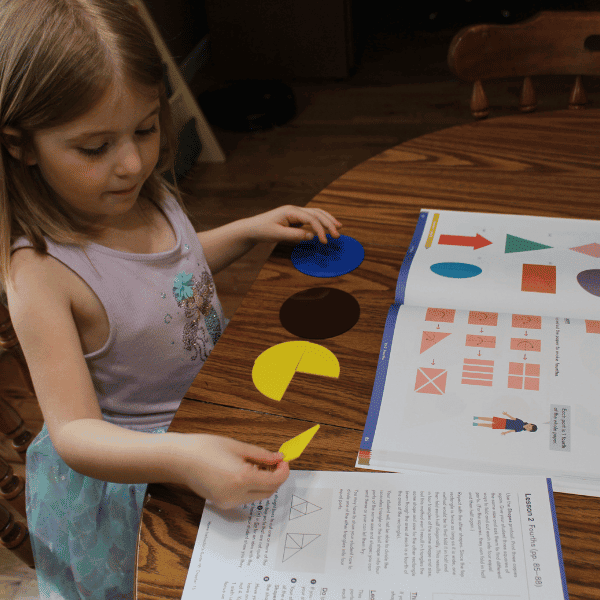
In the concrete stage, kids learn a new concept using manipulatives. These hands-on tools, like unifix cubes, place value discs, and Cuisenaire rods, bring math concepts to life. As kids hold and move these objects, they gain a deep understanding of new concepts.
Working with the manipulatives is always my daughter’s favorite part of each math lesson. I love that her math lessons are like a game for her!
Pictorial: Making Connections through Pictures
Next is the pictorial stage, where kids transition from concrete manipulatives to pictures and drawings. The famous bar models and number bonds in Singapore math are both examples of the kinds of pictures that the program is known for.
I love the colorful pictures found in the Dimensions Math textbooks. They keep my kids engaged in the lessons and help them make connections between the activities they did with the manipulatives and the math concepts they are learning.
Abstract: Mastering Math Concepts
With a solid foundation in the concrete and pictorial stages, kids can now solve math problems independently. In the abstract stage, we gradually transition away from visual aids, and allow kids to apply their understanding without the support of pictures or manipulatives.
As a teacher, I love this stage because it means that my daughter really “gets it.” It’s fun to see her confidence grow as she realizes that she doesn’t need the manipulatives to solve the problems.
Find Placement Tests for Dimensions Math here.
Easy to Customize
As a former teacher, I am always looking for curriculum options that I can customize to fit each of my kids’ unique personalities, learning styles, and abilities. This is one of the reasons why we homeschool, because I know that my kids will learn better and remember more when I’m teaching at their level, and in the way that they learn best.
I love that Dimensions Math includes everything that I need to customize the curriculum, without needing to find or buy any extra resources to do it. The curriculum includes a huge variety of options for different learning styles, including worksheets for my visual learner and activities and games for my hands-on learner. The lessons also include practice problems at a variety of different difficulty levels, so I can choose problems that are just right for each child’s understanding of each concept.
It’s important to remember that the curriculum isn’t designed for kids to need to do all the problems. This is great because it gives us permission to choose just the problems that are best for our kids, and skip the rest!
See Dimensions Math Sample Pages for every level here.
Teaching Singapore Math with Manipulatives
When teaching homeschool math, it’s important to use manipulatives. Manipulatives, like counters and blocks, are hands-on tools that bring math to life for students at any grade level. Manipulatives play an important role in helping kids understand new concepts and build a strong foundation in math.
Here are four reasons why manipulatives are important when learning math:
- Concrete Understanding: Manipulatives give kids a hands-on representation of important math concepts. Students can see and touch what they’re learning, and this makes abstract ideas easier to grasp.
- Problem-Solving Skills: Manipulatives are valuable tools for problem-solving. They help kids simplify complex problems and create strategies for finding solutions. Manipulatives help students develop critical thinking and logic skills.
- Building Number Sense: Manipulatives are especially helpful for kids who are learning about number sense. Students can physically group, separate, and compare objects, which helps them see and understand relationships, patterns, and math operations.
- Engaging and Interactive Learning: Here’s the best part – manipulatives make math fun! Integrating math games and activities into your homeschool curriculum keeps things exciting and interactive. Kids will enjoy the hands-on nature of these activities, which not only motivates them but also helps reinforce math facts and build fluency.
Check out the scope and sequence for Dimensions Math here.

Common Math Manipulatives
Here are a few of the most common math manipulatives that you will want to have on hand in your homeschool
- Base Ten Blocks: Base Ten Blocks are a set of manipulatives used to teach place value, addition, subtraction, and other fundamental concepts. The blocks are made up of units, rods (tens), flats (hundreds), and cubes (thousands), representing different place values.
- Fraction Tiles: Fraction Tiles are manipulatives designed to help students visualize and understand fractions.
- Unifix Cubes: Unifix Cubes are interlocking cubes that are often used to teach counting, patterns, number recognition, addition, and subtraction.
- Pattern Blocks: Pattern Blocks are a set of geometric shapes, including triangles, squares, hexagons, and rhombuses, each with a different color. These manipulatives are used to teach geometry, spatial reasoning, and pattern recognition.
- Your child’s favorite items: Small action figures, toy cars, seasonal items like jingle bells at Christmastime or bunny-shaped erasers at Easter, or your child’s favorite cereal or candy will all make great manipulatives. Personalizing your math lessons with toys or objects that your child is interested in will make math even more fun and meaningful for them!
Get more support for teaching homeschool math using Singapore Math, Inc.’s curriculum in the Singapore Math® Curriculum Users group!

Tips for Teaching Dimensions Math with Manipulatives
Using manipulatives with Dimensions Math makes the curriculum so much fun, and really makes it come alive for students. Here’s how.
Start With Manipulatives First
Dimensions Math is designed to follow the concrete-pictorial-abstract approach, which means that the lessons should start with manipulatives.
Using manipulatives is a great way to introduce a new math concept, especially to younger kids. Whenever we are learning something new, we start with manipulatives first to help my daughter understand the concept. Once she can do the problems confidently with manipulatives, it’s time to transition to pictures, or more abstract problems.
Starting with the manipulatives helps her understand the concepts and build confidence in her math skills.
I love the way that the lessons in Dimensions Math are organized. They follow this pattern of starting with manipulatives first. The ideas and suggestions provided in the lessons make it so easy to include manipulatives in our math lessons.
Personalize Lessons for Your Child
When you’re teaching a math lesson, your manipulatives don’t have to be the fancy ones that you see teachers use in public school.
My kids’ favorite manipulatives are always the homemade ones that I find around the house. They love using action figures, toy cars, or Legos as counters. My daughter has been loving “princess math” with a set of little princess statues we have. A favorite cereal or small candy is also a big hit. Not only is this a great way to save some money, but it’s also more fun for my kids and keeps them engaged.
Check out a full list of suggested manipulatives for Dimensions Math here– with a little creativity, personalized substitutes for most of these can be found around the house!
Make Some Changes
During my son’s first year of math, we used a textbook, but I don’t think he would recognize it- because he never actually saw it. I read the pages in the textbook so I knew what we needed to learn, and then I used manipulatives to teach those same concepts to him. This was a great strategy because he was struggling with fine motor skills and wouldn’t have been able to write the answers in the book anyway- but he could learn all the concepts with manipulatives.
As a former public school teacher, let me be the first to tell you that you don’t have to follow the lessons exactly as written- even in math. You can skip some problems if your child understands the concept, or add some extra math review activities if your child needs it.
That’s why I love that Dimensions Math is designed for this. The curriculum is designed so that you can pick and choose the practice questions and activities that fit your child’s math level. You won’t need to (and shouldn’t plan to) finish all the questions!
The curriculum also offers lots of suggestions for games and activities throughout the lessons. These are perfect for extra review!

Try Dimensions Math for Your Family
If you are looking for an excellent math curriculum that combines the strengths of the Singapore math approach with an easy-to-use format for homeschool families, I highly recommend Dimensions Math. I love the way this curriculum works with the science of how our kids’ brains learn math. It is so easy to adapt this curriculum to meet the unique needs of each child and to make the curriculum come alive with manipulatives that make learning math fun.
Learn more and get a copy of Dimensions Math for your family here!